
Trust by Raju Mandhyan

How to Trust and Acquire Trust

,

Tony Meloto is to the Philippines what Mohammed Yunus is to Bangladesh and what Jimmy Carter is to the United States of America. They are all founders of these NGOs that support the underprivileged. Tony Meloto gave up a lucrative career to build and grow Gawad Kalinga, which means to bestow care and support. In the last 25-30 years

Trust by Raju Mandhyan

Trust and Acquire Trust

they have built millions of humble homes across the Philippines, Asia, and the world. The initiative is creative, colorful and has succeeded with flying colors. Money, support, and volunteers flood in from all walks and all parts of the world.

One day at a conference that I was hosting, I cornered Tony Meloto and asked him how he manages this incoming wealth and support. How does he screen, filter, sort, and keep the whole thing transparent and running ethically? Are you not worried about corruption, politics, or fraud?

He paused, looked at me gently, and said, “We begin with trust.” We begin by first giving it abundantly at the get-go level, at the face value of the donor and the volunteer. In return, he said, we get it back trust back in spades and shiploads. That is how the system is structured, and that is how it works and it has not failed us so far. When we grant trust to people, they rise up to our positive expectations and often surpass them.

Such is the essential nature of trust and humankind. We wish to be trusted, we wish to trust others and the exchange occurs when we lead by offering it first. The offering of trust journeys through three phases. Call them the ABCs of trust. That is it needs to journey through appearances, behaviors, and communications with others.

When we regard another human being our deepest brain, the Amygdala, and the Hippocampus sections, within seconds makes an assessment of whether we like them or not; whether we should fear them or not; whether we should trust them or not. Thus, at this appearance level take in this assessment as data to be used for an integrated analysis of whether they can be trusted or not. Refrain from passing judgment just yet. Refrain from taking any action just yet. This information is only a third of the information needed to come to a conclusion.

The second phase is that of us watching and sensing their behavior. From years of watching and dealing with people each, one of us has a storehouse of behavior matching cards and metrics by which we assess likable or dislikeable behavior. Take note of these feelings, nudges of thoughts triggered by past memories. This is valuable data. Perhaps enough to come to a conclusion and then act but exercise pragmatism and hold back from judging the book by its cover.

The third phase is that of us listening to their words, their thoughts, their ideas about work and life. Hear them out totally. Maybe their appearance and behavior might be the total opposite of what they say, claim and commit.

Now you have data gathered from three different sources, three different modalities of communications. You have data gathered from sight, sense, and sound. Each of these sources has provided fodder that is data to crunched by our three brains; the deepest brain known as the Reactive brain which processes in the most primal way. We have behavioral data to be processed by our mid, limbic brain known as the Romantic brain and then we have data, cognitive-spoken kind, to be processed by our neo-cortex known as the Reasoning brain.

When all this data is done processing by these three brains and the final analysis compliments each other then you have found congruence. Then you have found trustworthiness. Now you can move ahead, take action.

That is the neural pathway, the journey of the thing called trust. That is how we trust and that is how we begin the process of trusting. Tony Meloto and Kalinga warriors, of course, do this in an accelerated way. They do it in a way that works for them fine and fruitfully.

What does it take from us, from leaders to trust others, and let our minds journey through these three neural phases?

It takes observing people through lenses that have the least possible bias. I am not saying without any bias, I am saying with the least possible and by staying conscious of our biases. If we observed people without any bias then we would have no opinions whatsoever. Thus, watch people closely, wholly, and gently.

It takes becoming sensitive to people’s behavior. It takes noticing and understanding of why people do what they do. It takes recognizing what kind of emotions are triggered with us when we watch and sense other people and their actions. It is about awareness, sensitivity, and being intelligent about emotions.

Finally, it takes active and acute listening to take in all that is being said and also exploring and understanding parts that are, sometimes, left unsaid.

These three phases of trusting others are tied in to three things we need to do, and all of them are in alignment with the structure and processing system of our triune brains. When we gather optimum data gently and process it quietly and thoroughly our abilities to assess and trust others improve.


Acquiring trust, on the other hand, is the reversal of this three-phase journey. When we want others to trust us then we must offer them the correct and honest appearances and presentations of ourselves. We need to let them see us plainly and openly. Masking our appearances is going to give others the heebie-jeebies over us. We need to become conscious of our behaviors and actions in the presence of others. Raising your voice, moving frantically or even positioning yourself where there is a lack of light will make others wonder about us. Lastly, thinking well before speaking gently and succinctly about things helps others get a clearer picture of us. It helps them go through the process of integrating the data and the analysis through the three phases and with the triune brain efficiently. This when practiced with consistency builds relationship trust. We can do the same with acquiring trust in our competencies; be good at something consistently.

Building a culture of trust in other organizations is an enhanced and a multi-layered approach of this interpersonal process of giving and acquiring trust. When the process becomes clear to the leaders of any organization, they begin to live out the process. Living out the process makes it habitual and, eventually, becomes second nature to leaders. When leaders are good at giving and getting trust then the philosophy and the practice cascade across to become the culture of that organization. Trust me.
Resilience and Rapid Business Recovery

,

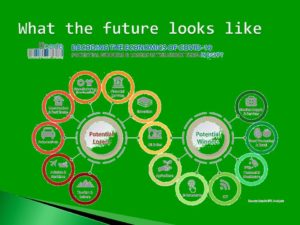
We are in the midst of a crisis, the kind people have not seen in a hundred years. Neither has all the workforce of the world been kept away from being industrious for such a long time. This lack of activity, lack of being able to produce will have a huge impact on the global economy; on production, trade, services and the flow of money across nations.

What it means to large corporations is that they will have to drain their liquid and non-liquid assets. Smaller business will have to get back to work as if they were starting up all over again. Both, the big and small, will also have to scrape the bottom of their resources. We will have to renew structures, rehash systems and respond to a brand new world, a brand new normal. We will all have to bounce back faster and stronger as if we were an amalgam of steel and rubber.

There are five things that every business may find wisdom in:

1.Assess all impact:

When the earth heaves and hoes, all plant and animal life gets displaced. When the global economy will turn a side, every industry will be impacted. Travel and tourism will come crashing down while food production and delivery will take an upward swing. Education may not win or gain but will have to scramble to stay steady.

Conduct an honest SWOT analysis of how hard you will be hit. Do remember that being hit positively also will require adjustments and adapting. Grabbing new opportunities require renewed strengths.

An extremely popular ramen restaurant in Makati, Philippines has an obsessively loyal clientele. Prior to the COVID-19 crisis, people would line up and wait for hours to dine there.  They were an eat-in restaurant only.  Now they’ve had to shift to delivery only and their loyal clients still wait for several weeks for their dinner to arrive. Imagine pre-ordering a dinner three weeks in advance.

It is a happy challenge. It is still something that needs focused attention.

2.Reinforce partnerships:

Most everything atrophies. Most everything atrophies a lot more rapidly when its environment is unsupportive. With the slowdown, the focus of people in all industries will have shifted inwards. As and when they get back to work, they may have difficulty remembering where the power switch to their machines might be. This will not be true just for your own teams but also for the teams of your partners on the supply as well as the demand side.

As and when things begin to look like normal, one of your first priorities ought to be catchup with and energize relationships both with your suppliers and buyers. Get an idea on how they were impacted, what their new needs might be and how you can support them back to their feet too.

No man, no business is an island. Even islands, in reality, are connected to each other inside the core of the earth. When we help our associates, our partners and even those that we consider our competition, providence opens up new connections and new doors for us, for our businesses.

3.Tighten the organization:

Weeks before any bout, professional boxers turn away from indulging, eating or drinking anything that is non-essential to their preparation. They spend a large part of their time training, studying the opposition and visualizing success. The discipline is fiercely rigorous, and it usually brings success.

Likewise businesses will have to cut down fat, inefficient processes and costs. Make your machine a lot leaner than it already might be. Let the fire in your belly rage ethically and consistently. This may also mean letting go of assets, investments and projects that are weighing your ship down. Dump them. Cut losses fast and early. There will come a season to recover.

Seek alignment from your people, work on increasing employee engagement and become obsessive about indulging in value-creating, measurable activities only.

4. Upskill abilities, agilities:

Chances are your empathetic culture makes you carry people-assets that may be slow moving and low on performance. Practicality says let go of low-performers, wisdom claims that this may not be the time because it will dampen the emotional resolve of the whole organization. Instead spend on upskilling them all.  Learning and development is a discipline that aligns itself with the doddering educational industry. It stands on unsteady ground in a crisis such as this, but when tightening your organization and changing the course of your vessel, it is people we will need.

It thus, makes a lot of sense to sharpen the abilities and the agilities of your human resource. Train them fast, train them hard. Enroll them to stretch their limits and master new systems and machinery. Encourage a mindset of maximum frugality when it comes to investing time, money and effort.

Alliance Global Group Inc., which owns Emperador, rapidly swung their ship around, mid-storm, from producing alcohol for consumption to alcohol for disinfecting in less than three weeks in this current crisis. Not only did they swing around their output but they also donated 1 million liters of their produce worth $5 million to the community at large. More than just resetting their machines, they also had to sustain employee engagement and upskill their abilities and agilities.

5. Go beyond borders:

Up from the time when we sent our first email, the world has been going digital but with a certain lethargy towards it. Gartner, Inc., a research and consulting company claimed that only 12% of the world’s businesses were ready for the current crisis and only 32% of the world’s business leaders update their business model.

Yet in the last six weeks almost 35% of the world’s learning and development community have moved up their services to online versions. They have agrresively reacahed out beyond their usual geographical and familiar limits.

It is not just about getting digital but it is also about harnessing big data, increasing accessibility, improving communications and insuring security and safety on the digital space.

Tata Consultancy Services, the Indian IT services firm, plans to adapt remote working conditions introduced as a response to coronavirus into a permanent working model for 75% of their employees globally by 2025.

Not that these five ideas are the most brilliant in the world. Like all plans and strategies they involve a lot of guesswork and gutwork. Take what works for you. In any and all cases stay eco-conscious and be kind to the earth. A decade ago we were talking about surviving disruptions brought about by technological advances in a VUCA world. This disruption is brought about biological mishaps. Use these five simple ideas to build a brand new, better world ahead. Remember that when the night seems too long, the days ahead will be brighter and beautiful. Check video on Traits of the RESILIENT.

Raju Mandhyan

the ABC’s of Higher Impact on ZOOM

Assess and improve impact on ZOOM

COVID 19 and Community Quarantine across the world has had a major impact on how we run meetings. Up until seven weeks less than 10% of us worked from home. Last week MIT ran a survey on 25,000 executives and found that nearly 35% of them have hopped on the virtual workspace and are working from home.

After these tough times are over and I do believe that this too shall pass but working virtually and business meeting on Zoom and other platforms will become the new normal. Most all the skills and competencies that we’d learned in the past for connecting, engaging and influencing small and large audiences will have to be flipped around to fit onto laptop screen or a handheld phone.

Here are a few ABC’s of higher impact and influence on Zoom which you may find handy in these fast-changing times.


First, the A about you appearance:

  1. Dress and groom yourself appropriately for the kind of meeting you are going to participate in. Had the real-life, physical meeting called for business formal then, from home, wear at least business casual clothing. My preferred colors are plain with no prints and usually on the dark side.
  2. Make sure that your workspace and background looks presentable and is not too distracting. On Zoom there are features which will allow you to create virtual backgrounds like on a green screen but this sometimes chips away at the outlines of your face. So be careful and test it first.
  3. When you face the camera, make an effort to sit upright and look straight into the tiny camera most off the time. Make it also a point to fill up at least 50% of the screen real estate. Do also make sure to sit facing the light rather than having a light drop in from behind, above or below you.


Second, the B, about behavior:

  1. Do remember that you are on camera and the camera watches you 100% of the time mercilessly and without blinking. There’s also a good chance that the host of the meeting, if not you, maybe recording the meeting.
  2. Thus, stay focused, fresh and attentive. That means manage your movements and keep your gestures close enough to stay in the frame. Refrain from twitching, scratching, grimacing, making a face, raising your eyebrows etc. Do remember that action speaks louder than words. In this case of virtual meeting even your micro-gestures will get magnified and caught on tape and remembered forever.
  3. If it helps keep a notepad by your side to help you with your talking points and point to remember from the meeting. This will help you stay focused, structured and will subdue unnecessary non-verbal communication.

Third, the C, for communications:

  1. Our words create our worlds. Words once uttered out cannot be withdrawn, erased or deleted. My father, a tailor by profession, used to always say “measure twice, cut once.” Same is true for speaking out. Before speaking out listen thrice as much, think twice and then speak once.
  2. When you speak a few decibels louder than your usual and speak a wee bit slower than you normally do. Pause often and take longer pauses after expressing a thought or an idea.
  3. In the physical world good pausing adds drama and increases impact. In the virtual world it does all that plus it allows you to check the smiles, the nods and the responses of scores of faces on your laptop screen.

Lastly, the most important  ABC’s of higher impact and influence in virtual meeting is that for heaven’s sake sit down or stand upright calmly during a virtual meeting. One time, I was in this online meeting of speakers and trainers from across the world when one of the ladies was jogging on the streets of her hometown while talking to all of us. Though I was properly seated at home all that bouncing and jiggling of one of the little images on my screen was giving me motion sickness. It was terrible.

Anyway, I hope these ABC’s of higher impact and influence in virtual meeting help you. I also hope that we, all the people of this beautiful earth come out on top of this current crisis quickly and safely. I am sure it will be a brand new and a better world that we will be living in from here on.


Raju Mandhyan

Tenacity through Tough Times

These are tough times.

Tenacity through Tough Times!

 
These are scary and very unusual times.
 
Neither I nor every elderly person I know or knew have experienced anything like this.
 
Yes, there was scurvy, leprosy, polio, WW1, WW2, Holocaust, Tuberculosis, Hepatitis, SARS, HIV and even 9/11. They were all scary, lethal and very damaging.
 
Yet none of them was as invisible, as undetectable and with a potential to shroud and sicken in such large numbers over such vast distances, and at such a rapid speed.
 
It has brought the whole world to its knees, it has even slowed down time.
 
Yet, a part of me is telling me that even though our knees may have buckled, even though our hearts have been grabbed by a chilly, macabre hand our spirits still burn.
 
On the streets of Philippines where I live, where people love being close to each other, support and and care for each were for some days taken by surprise and shock.
 
It was against their very nature to keep away, to not support and not care. In the last two days small gestures and conversations of care, compassion and courage have begun to emerge.
 
Yesterday, I heard a young leader claim that she’d stand behind and support her small team of four, who still had to physically report for work.
 
Half the consultants and coaches I personally know have moved half their value creating work online for their clients at no cost.
 
Many doctors and health workers have swore to stay on and work in the hospitals until this battle is over.
 
This morning, a Sunday, a few homes across my place I heard church services being conducted. To me that is a sign. A big one. A sign that says we will all, across the world, break through and climb over to a shinier and a brighter day, to shinier and a brighter world.
Yes, it will be a totally brand new world from here on and it is bound to be a lot more creative, courageous and compassionate.
 
Raju Mandhyan
On April, I am inviting you to an online chat on “Tenacity through Tough Times,” please click to learn more and sign up. The first 25 seats are complimentary.
Learning to Learn

Nothing Beats Learning to Learn

, , , ,

A few years ago, I had the honor of interviewing the Director of Application Services of Hewlett Packard, Philippines, one Mr. Noel Mendoza and though the subject of our discussions was information technology and its growing impact on the world, there was something he said outside of the interview that got velcroed to my heart and I share that thought with you here today.

Learning to Learn

Raju Mandhyan at the American Management Association

Noel Mendoza mentioned that his father, the distinguished Professor Gabby Mendoza of the Asian Institute of Management had left an indelible mark on him and that mark stated that nothing is more important in a human being’s life than building and sustaining one’s ability in learning to learn. No diplomas, no degrees or doctorates granted by any institution can match up to one’s ability to become a self-driven learner at work and in life.

And, what applies in our daily lives and in our self-development and leadership initiatives alos applies to selling and serving the needs of our customers.

Years ago there was this humorous story about an inept salesman selling Bibles across the small towns of America was going around the internet. It’s a great story and puts across the point of eagerness and learning.

This Bible salesman would knock upon the doors, mumble his way through his introduction, stumble through his presentation and make an overall mess of what was considered to be an easy sale back in the day.

Upon seeing his inadequacy at his job, most of the people answering the door would get frustrated at his approach and respond with,

“You don’t know a thing about selling, do you?”

“No, ma’am, not really! I am new to this job and also quite clumsy around it.”

“Oh, you nitwit you, there’s nothing tough about selling, you know!”

“Yes, ma’am, you’re absolutely right. I need to trust that fact.”

“Oh, come now,” they’d rebuke, “let me show you how.”

And, the customer would then go about teaching this nitwit of a salesperson how to sell correctly. Well, at the end, you guessed it. His sales multiplied and he often made it to superstar status in his company.

His approach might be considered tricky today, but the essence of the Bible salesperson’s story lies in our wanting to learn.  When your buyer senses and is convinced you want to learn about them to help them improve, then they often lean over backwards and hand you their trust in spades.

My belief is this ‘wanting to learn’ is about innate curiosity. This desire to learn and add value is the anti-thesis, the opposite of what has been considered a standard selling process. In the standard selling process, the seller shamelessly shoves features, advantages and benefits to the prospective buyer.  The reversal of this attitude and the desire to learn creates a good vacuum that draws the buyer in to where solutions can be created.

I massively trust and profess success from the process of inquiry and questioning at any time and place.  This is the process of diagnostics and counselling that community workers, therapists, and doctors utilize. It is the process of interacting, learning and understanding our clients prior to prescribing solutions.  Interacting, inquiring deeply to learn about the customer is the true Heart of the Close.

A good teacher makes for a non-intrusive and gentle guide who creates an atmosphere to encourage students to think boldly, to talk freely, and to act judiciously. He makes available opportunities for them to exercise initiative, to grow and shape their own growth and development. A good sales leader does the same for his customers. He helps them create their own solutions and own them for tomorrow.

Raju Mandhyan

www.mandhyan.com