

the HeART of the CLOSE: What Sales Coaching is Not

,

Let me start by talking about what coaching isn’t.  Coaching is not telling.  It is not teaching, not training, and not even mentoring. When you tell something to someone, you deliver sound and the listener probably hears it. Does he accept, understand, and act upon it? Only he will know and only he can say.

Coaching is not teaching. Teaching is when your listener doesn’t know the subject or the skill at hand as well as you do, and so you explain and maybe demonstrate. In this case you need to know the subject at hand much better and deeper than your listener or student.

Coaching is not training. Training is when you facilitate the learning of a skill; say biking or using Microsoft Excel. You can be referred to as a “coach” but you’re not truly coaching in the real sense.

Coaching is not mentoring. Mentor is the name of a man in whose care Telemachus, the son of King Ulysses of Ithaca was put under.  Ulysses (also known as Odysseus in Greek) asked Mentor to look after his son when we went off to fight the legendary Trojan Wars which lasted 20 years.  Apparently, Mentor did such a good job of caring for Telemachus that the word “mentor” moved into the language as the name for a person who teaches principles and practices to his pupil and protégé. Thus, you mentor someone also when you are better than him in specific  subjects and skills.

To be a coach or to coach someone, you do not have to necessarily be better than the person you are coaching in that specific skill set. To coach is to evoke and to facilitate the unlocking of innate potential in the person you are coaching.

The professions that come closest to coaching might be a combination of doctor, counsellor, and guide. Yet these three are not quite coaching because they somehow prescribe and indoctrinate.

Coaching provides context but no content. Coaching provides the framework but doesn’t provide any principles to the one being coached. Coaching only challenges assumptions, unearths desires and strengths and then maybe co-designs a strategy to achieve those desires and optimize those strengths. A coach helps sets goals and then watches you while you execute and achieve them. There are thousands of definitions of coaching and thousands of principles for practicing coaching.

To establish a clear understanding of coaching let me, again take you back a few hundred years in time to Italy and modern day Rome.

In Florence, Italy, a young sculptor was commissioned to do a statue of a well-loved Biblical character out of a discarded Carrara marble piece. It was a project nobody wanted to be part of. Many other sculptors said the piece of marble was rotten, porous and scarred. None of them wanted to be associated with such work lest their names and honor be tainted.

Young Michelangelo, as he approached and circled the stained and scarred rock, paid little attention to the rumors or the damaged external conditions of the rock. His eyes and his heart saw only the beauty and elegance that lay hidden inside the rock. He imagined what the rock could become when all the unnecessary parts were chipped away by his skilled and caring hands. After many days and nights and months of laboring with love and chipping away the unnecessary from the rock, artist Michelangelo succeeded in unearthing and bringing to life the amazingly beautiful statue of David.  It still stands tall and proud at the Galleria dell’ Accademia as a homage to an artist –a coach who saw beauty, brilliance and potential in a piece of discarded rock.

the HeART of the CLOSE by Raju Mandhyan

the HeART of the CLOSE by Raju Mandhyan

That, essentially, is the heart of coaching. It is the art and science of seeing something powerful inside of others and then carefully, lovingly and scientifically releasing and unleashing that potential.  To be a coach is to be an awakener of sorts. To be a coach is to be an almost invisible, non-interfering guide by the side of your salesperson. Yes, that is coaching!


Taken from my upcoming book, the HeART of the CLOSE.

Find more insights like this one in my other books on Amazon

Connect with me on Facebook/Raju Mandhyan
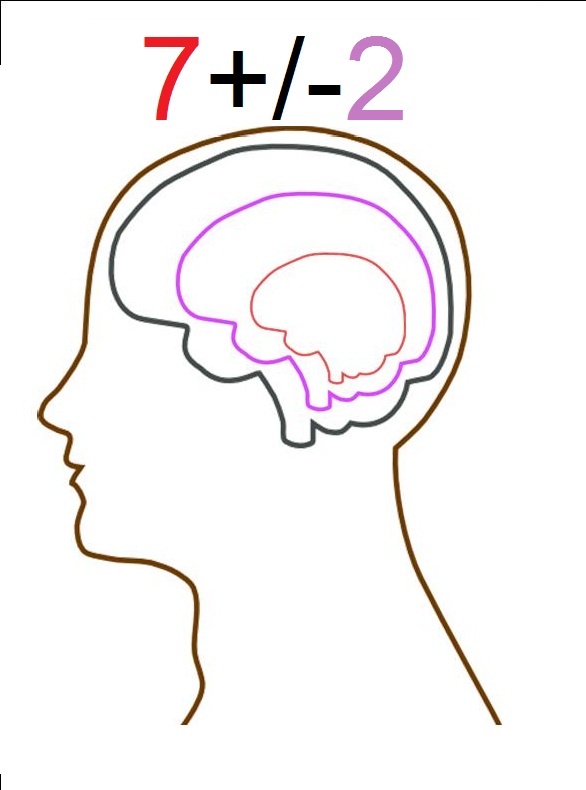
Seven Plus Minus Two from NLP

Have you ever walked into a meeting late, because of heavy traffic en-route, and been unable to concentrate on agenda at hand right away? Does a part of you want to focus on the work while another part of you is still anxious, stressed and testy about the traffic conditions you just recovered from?

Seven Plus Minus Two Principle from NLP

Seven Plus Minus Two Principle from NLP

Or, at times, have you tried to pitch a presentation to an important customer, behind a large desk, who is signing papers, taking calls, punching his keyboard, sipping coffee while politely asking you to keep on talking. He claims he can multi-task and is listening to you but at the end of your pitch you still feel let down.

Meeting maladies similar to these can be resolved by understanding, in depth, another principle of Neuro Linguistic Programming: At any given moment, our conscious mind, can only hold and juggle with seven plus or minus two chunks of thoughts.

For example, while driving through traffic, you are intensely navigating, formulating an explanation for your tardiness, reviewing your planned presentation, pondering upon discussions or activities you may have concluded earlier, reading your messages on your phone, planning the evening, regretting not having eaten a healthy breakfast, thinking of the family, etc;  All this is hyper-mental activity. And, some of the areas that we reactively think about can be switched off to be able to calm yourself and focus on what is crucial. Just like a computer, the desktop of our mind can be faster and more efficient if it is running fewer applications at a given moment.

Your obvious question would be how do I do this? That’s correct. For yourself, you need to become conscious of the fact that you are running in a hyper mode and then zero in on your breathing and focus on it. A few minutes of paying attention to your breathing will shut down several less important issues the desktop of your mind may be juggling. If your mind wants to react, stop and go back to focusing on your breathing. In the long term practice will make you perfect.

How do you handle the customer behind the large desk, who wants you to go on talking when you know he is running in a hyper-mode and may not be giving you a hundred per cent attention? Stop speaking, slow down your presentation, deliberate on your pauses, and politely ask him to finish signing the papers or answering that email. Like: ” I see you like answering off important emails promptly?” That’ll break his trance, his pattern and he will look up and give you attention.

Ask him non-probing questions about the biggest chunk of thought he may be juggling on the desktop of his mind. Do or say anything that you feel will help him switch off some of the activities and give you better attention. A word of caution: Don’t be cheeky or obvious about it because that may embarrass him.

In summary, powerful leadership conversations are also about understanding and managing the subjective state rather than just what is on the surface. Practice these methods and you will find yourself achieving a lot more in half the time and at half the cost.


Find more insights like this one in my books on Amazon

Connect with me on Facebook/Raju Mandhyan
Storytelling Legacies of Leaders

In the mid-1930s India, a spritely old man wrapped up in loincloth spoke of freedom, compassion, and peace.  Mahatma Gandhi carried a big stick, marched across the nation to pick up a fistful of salt by the ocean, and eventually liberated the country. He spoke to his people through painted visions and he touched hearts through parables of possibilities, “Change,” he said “must come from the inside. We must become that change.”

Connect, Engage and Influence your World Creatively!

A few decades later in America, another visionary stepped on the podium and shortly after, set aside the text of his prepared remarks to improvise.   Addressing a crowd of many thousands, he declared his dream—people from all corners of the country, from all walks of life, children of all races living together as one “to turn the jangling discords of our nation into a beautiful symphony of brotherhood.” He announced his vision to the world to change a nation.

In the early 1980s in the Philippines, a journalist-turned-statesman chose to stand up against tyranny.  Amid the toughest of odds, he flew home, stepped off the plane, and walked into the waiting jaws of death.  This act of courage gave life to a story that inspired millions to act.  Fired by his example and call of, “The Filipino is worth dying for!” the first ever people power revolution produced a peaceful transfer of leadership and changed the country’s future. People power became a global model for bringing about change at the country level.

In comparison to the last 20 years, the rate of progress and the proliferation of information and technology have been exponential and show no signs of plateauing.  How people will regulate and sustain life stories in the future is unimaginable.  The stories of today are flourished in diverse formats. They are told and retold to sound and music, in dance, in art, in words, in moving images, all in bytes and pixels.  Stories travel, morph and multiply at the speed of light with a cursory glance and the touch of a fingertip.

Will this explosion of knowledge and ideas through technology ever change the concept and the heart of telling stories? The answer is a flat out no!

Here’s why:

  • Wherever they may sit, leaders enhance their credibility and authenticity through storytelling to spark the change they seek. Storytelling does much, merely by advocating and counter-advocating propositional debate, which leads to increased discussions.
  • Storytelling is focused on the future. It is not just an extrapolation of the present. It swirls emergent, new phenomena and nourishes it by downplaying the doubts and misconceptions of yesterday.
  • Stories are about human empowerment and real transformations in organizations. Stories are about humanity. Stories are about us transforming into a better us. Stories are about us wanting to know who we are and about us wanting to reach for the stars.

A story is like mist that develops on the outside, but the wisdom emerges from the inside. When a story touches our hearts, it takes hold of us forever and silently sets us free. This is a never ending journey.  It is also a never ending symphony. As long as this quest exists, stories will always fuel and fire us. And, since this is a never ending quest, we will always be leading ourselves and others happily into the ever after through stories.

That is the HeART of stories.

Drawn from the book, the HeART of STORY on Amazon.