the HeART of STORY:Stories, How they Serve Organizations, Part 2

Mention the name of Tata in India and every loyal Indian consumer will raise her chin higher as her eyes light up in approval. For nearly 75 years now, Tata and all its divisions have been serving the Indian nation well.   Yes, they had a difficult start in the troubled times before Indian independence, but they persistently held on, determined to focus on quality and to serve a young and a hungry nation. Over the years, families, employees, and all other stakeholders in the Tata group of companies have each had a story of his own to tell. In the 1960s and 70s, skilled workers would queue up for jobs in the production lines of Tata Motors. Once in, they would consider themselves successfully settled and would stay with Tata for life.  Such was, and still is, the reputation of Tata Group of Companies in India.

Connect, Engage and Influence your World Creatively!

Tata knows this and consistently organizes and aligns itself to the image and expectations that stakeholders look for in this brand.  In the 1990s when the Indian economy picked up momentum and produced a larger middle class, Tata realigned itself to the growing needs of a new nation by providing them with the world’s cheapest and most fuel-efficient car, the Nano.  Today, Tata continues to be ranked the number one brand in India and among the top 50 brand stories of the world. Images, emotions, and relationships in the form of stories have been the drivers behind this magnificent performance and brand from India.

In the Philippines, no matter how many times it is repeated, the story of how Jollibee Hamburgers started off as a little family-owned ice cream parlor always brings a sense of pride.  This success story is wrapped in deep, powerful Filipino values of family cohesiveness, nationalism, and the endeavor to constantly improve and innovate. Embedded in this brand story is the legendary David-and-Goliath plot of how a small, insignificant entity took on a giant, global hamburger chain and brought it to its feet.

Regardless of another global brand’s performance being  a few notches higher in the world stage than that of Jollibee, its “story” as being born of a humble Filipino enterprise that respects and appreciates family and togetherness makes Jollibee  the nation’s best-seller. Jollibee knows this to be the reigning reality. They continuously exert all-out efforts to improve their products, service, and performance not just to elevate quality standards but also because they are motivated by the stories that come with the brand.  They are smart to do so.   It makes good business sense and it makes good developmental sense. Living up to your brand stories is a sensible and a strategic ideal.


Drawn from the book, the HeART of STORY on Amazon.

 

the HeART of STORY: Stories, How They Serve Organizations, Part 1

Today, there are huge developmental benefits that stories and storytelling deliver beyond unleashing creativity, using metaphors, and the philosophy that backs them. Yes, stories in storytelling are not just about people. They are also about nurturing the planet and pushing up the profits in business.

Stories help us connect with distant entities and cultures. Stories sustain and consistently enhance the levels of engagement within our own organizations, communities and cultures. Stories are the magical and metaphorical processes by which we can ethically influence our market and all our stakeholders in a creative manner.

Connect, Engage and Influence your World Creatively!

Stories Strengthen your Brand and Identity

Coca- Cola in the US, Tata Motors in India, and Jollibee in the Philippines are not just names and good products. They also have a very specific character and a whole personality attached to their names.

Utter the name of Coca-Cola and suddenly, the cognitive and perceptual screen in consumers’ minds explode with brilliant fireworks.  Phrases like “It’s the Real Thing, Coke Adds Life, Coke is it!” constantly pop into our heads. Beyond the immediate responses related to its, name there is also the assurance of quality, performance, and a unique dependability in all Coca-Cola products. This type of response and relationship with the consumer did not come about just recently. It came from an accumulation of thousands of experiences, emotions, and stories attached to the product and its partnership with people.

Coca-Cola is aware of this so it nurtures and protects this massive, intangible asset with the same ferociousness it applies in guarding its secret formula for producing the bubbly, cola drink. Coca-Cola knows this so it regularly fuels the fires that keep this relationship burning by creating new stories, new emotional attachments with its customers.

A few years ago, Coca- Cola churned up heart-warming emotions between India and Pakistan by putting up vending machines using 3D touch screen technology so that the peoples of these quarreling nations were able to see and mime and touch each other, virtually.

The history and relationship of these culturally similar countries and people is that from being one country, it was split in two more than sixty years ago. Many factions on both sides are still upset over the split that happened in 1947.  Each side is still unhappy about friends, memories, and homes that they left behind during what was called the “partition.”  They have fought several wars since then, quarreled over borders in the beautiful state of Kashmir, and blamed each other for cheating in sporting events.  Generally, their people are extremely suspicious of one other.  It was a gargantuan task for Coca-cola to bring together these two peoples into a life-sized, virtual interaction.

The campaign called Small World Machines provided a live communications portal linking strangers across the borders of India and Pakistan. First-of-its-kind 3D touchscreen technology projected a streaming video feed onto the vending machine screen while simultaneously filming through the unit to capture a live emotional exchange between people miles away from each other.

Jackie Jantos, former Global Creative Director of Coca-Cola, claimed that the idea of creating stories around shared experiences went back to its roots.  Coke started at a soda fountain which in itself is a communal experience. The India-Pakistan interaction might have been a virtual one but the emotions were real and open-hearted. The project not only endeared the Coca-Cola brand but also earned a lot of respect for Coke.

This is Part 1. Allow me a few days to upload Part 2. Enjoy!

Check Video on You Tube; the HeART of STORY

Download from Slideshare: the HeART of STORY

Don’t Think of a Pink Elephant in 2015

I am not in the habit of using the word “not” as often as I used to, when setting goals.

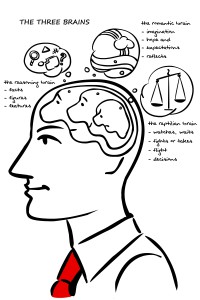
The reason is simple. Our triune, naturally positive and highly visual,

Appreciative Feedback

brain does not accept a negative command.

Try, when I say, NOT to think of a Pink Elephant.

Please do not think of a Pink Elephant.

What are you doing? What’s on your mind? A “Pink Elephant,” you say?

Right!

Your visual brain had to first upload a picture of a Pink Elephant and then it made efforts to delete it.

Tough!  Real tough!

So, let’s say you want to NOT be fat this year and you will work at it. What is your brain doing and what will it do during the period you work at NOT being fat? It’ll be holding up a picture of a FAT YOU to motivate you to NOT being FAT.  The whole exercise backfires on you, you become what you visualize-FAT!

So the goal-setting and building good habits in 2015 way is to claim what you want to Be, Do and Have rather than NOT be, NOT do and NOT have.

So, here’s an example goal stated positively. Stated in a way where the picture is consistent, affirmative and in a language of “as if” I am already what I want to Be, Do and Have.

“I AM AN EXACT 175 POUNDs AS I STAND ON MY WEIGHING SCALE ON THE MORNING OF MARCH 31, 2015. “

I can add to that.

It is fine sunny morning. I am in my bedroom. My window is open and I hear the leaves in the garden rustle. My waistline feels flat. My trousers feel loose and light on it and my back muscles are nice and sinewy. I like myself.

With that living, breathing, vivid picture in my mind, I work a plan of;

  1. Eating ONE whole meal of just fish and all green vegetables every day.
  2. Drinking 12 glasses of water every day.
  3. Biking for 30 minutes every day.
  4. Swimming for 30 minutes on every Friday, Saturday and Sunday.
  5. Sleeping for a minimum of 7 hours every night.

After consistently working this Neuro-SMART plan and checking my progress every 15 days,  there I am on the morning of March 31 weighing exactly 175lbs.  I flex the muscles on my back and feel good about them.

Do you see that?

Can you do this for, say “HAVING A MILLION PESOS IN YOUR BDO SAVINGS BANK ACCOUNT ON THE MORNING OF JUNE 30, 2015?”

Of course, you can!

That is easy, peasy, lemon squeezy!

You can see it, smell it and feel it but I did NOT say that did I?

Have a Happy 2015!