
the HeART of Story : History of Storytelling

Eons ago, when man discovered fire, he also discovered the wonder of telling stories around that fire. After a hard day’s hunt, he would gather his tribe and begin to converse and tell great stories. He told stories about the source of life, about the sun, about the moon and the stars.  He also told stories about the time and place where the sun was born and how the moon romanced it.  He told stories about how the moon pursued the sun and died every month to be reborn to love the sun all over again. He told stories about how every individual had a star of his own up in the teal and midnight-blue skies.

Connect, Engage and Influence your World Creatively!

Day after day, night upon night, from one season to another, man told stories –tales about love, courage, adventure, conquest, and wars. Around the fire, he told stories of ferocious Spartan warriors and heroes that battled one-eyed giants. He told stories about birds that could fly into the sun, burst into cinder, and then rise again from the ashes to fly right back into the sun.

Over the ages, stories of tradition, honor, and great courage ruled the air around the fires. There were stories told about great escapes, bold robberies, and giant shipwrecks. Discoveries were reported about new worlds, new wealth, and new people. Narrated with rhyme, repetition, and rhythm, all these stories were etched on the walls of the caves where our ancestors lived and into the hearts and minds of all mankind.  Shadows and echoes from the flickering fires left unforgettable legends visualized and represented on the walls of our current homes.  Today, many of these stories have become a large part of belief systems, of our culture and our tradition.

Storytelling Today

The ancient art of storytelling has turned into a science riding on the wave of television and technology as a laughing, talking, singing universe. This universe now surrounds us twenty-four hours a day and also reaches us through books, song, dance, stage-plays, movies, television, computers, and phones. It does not let go even when we are 10 kilometers up in the air and zooming across the skies at over 500 kilometers per hour.ccc

Stories grab us in news reports, magazine shows, commercials, documentaries, television serials, musicals, and films of epic proportions. Stories reach us through multiple media in formats like short episodes, interactive applications, gaming applications, etc.

The ancient, traditional face-to-face, oral storytelling has also morphed with the integration of poetry, improvisation, mime, and other forms. Seasoned, professional storytellers can keep us awe‑struck and engaged in their verbal and non-verbal gymnastics for hours on end.  Seasoned storytellers, thus, can influence and positively transform our worlds.

Leader as a Storyteller


Check out my book,the HeART of STORY, organizational and leadership storytelling…on Amazon –


Laughing, Talking Sunshine!

“Grandma, why is there no sunshine in your room? Why is it so musty and always dark in here, Grandma?” asked li’l Teresita of her grandmother.

“Well, it’s because the room has no windows, child,” replied the kindly old woman.

“I am going to go and ask Daddy to install some windows right away,” she responded and ran down the spindly stairs towards the living room of their house.

The house they lived in was wedged between several other tall, scrawny structures and the back of the house hung on for dear life to the rocky hills of their little town in the province of Quezon, Philippines.

Her father was sitting on the dining table sifting through bills to pay that kept piling up from month to month. Her mother’s back was towards her and her father. She was busy stirring up some food on that, slightly chilly November morning in the Philippines.

“Daddy, Daddy I want us to place some windows in Grandma’s room upstairs in the attic. It’s too dark and musty there when we play,” she said in an excited and eager voice. Her father did not respond but continued to arrange and re-arrange the papers on the table. Teresita hopped up a chair and held his arm and shook it, “Dad, the room is so dark that we can barely see little shells we use for the Soonka* game we play. Please, Daddy!”

He dropped the papers and the pen he was holding, leaned back into the chair and sucked in some cold air. “Tess, our home is cramped in between other homes and has a rock-face behind, we can’t place a window anywhere in that room.”

“But Daddy, the room is so dark, so musty. Please Daddy place in a window. Grandma will be happy. We’ll be able to play,” she said in a raised voice. Her mother let go of the spatula she was stirring the food with, turned around and a lump formed up in her throat. She knew her mother who’d been their dependent for years now was getting old and they were living through some hard times. Her husband worked hard but he was still unable to bring in enough. “Don’t be such a pest child! Our home faces south. We have no money. There is no way we can place a window in Grandma’s room!” he snapped at his daughter. Teresita’s mother saw her little girl’s face shrink and her eyes water as she got off the chair and ran out of the house sobbing.

Out on the street, the sun was about to set and the country breeze quickly dried up the tears that had run down Teresita’s face. Within moments she got engrossed with the birds, the bees and the flowers that abound in the provinces of the Philippines. The evening sun was kind on her face and as the sun-rays fell on her arms, she smiled warmly, “Why don’t I,” she thought to herself “catch some sunshine and then bring it up to Grandma’s room in the attic?”

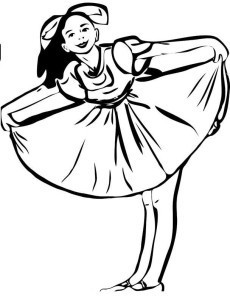
Quickly she held up the edges off her long, frilly skirt and faced the sun so the rays fell right into the open, carved out apron front. She held her breath as the apron-front of her skirt filled up with sunshine. She quickly scooped it up, brought the ends together, captured the sunshine in her skirt and ran up to Grandma’s room. “Grandma, Grandma, I brought you something. I brought you sunshine,” she yelled and let drop the apron-front. Nothing happened. She was shocked. “I brought you sunshine Grandma. I really did. I don’t know where it went,” she said as her lips pursed up in pain. “Oh, not to worry,” said her Grandma “come let me tell you a Christmas story.” She grabbed, scooped up the child in her arms and began to tell her a story.Teresita-230x300

The next morning, Teresita was out again playing in the yard. The sun was brighter and richer upon her as she played in the yard. “This time” she said to her-self “I will not fail. I will not spill the sunshine as I run up to Grandma’s room.” She held out the front of her skirt for a longer time. When she felt the heat gather, she wrapped it very tightly and then sprinted into her house and up the shanty stairs to her Grandma’s room and announced, “I brought sunshine. I did. I did!” Yet, when she let drop the apron-front of her skirt there was nothing. Again the grandmother scooped her up in her arms and began to hum her a little love song.

On another day Teresita resolved to win against the disappearing sunshine from her trap. She glued a large piece of a black, plastic sheet to her skirt’s apron-front. She grabbed a few clothe-spins and set out onto the front yard. With her jaws tightened and her lips narrowed, she faced the sun with squinted eyes and held up the plastic-coated, apron-front of her dress for a long while. With a large swing of her hands, she mightily closed and captured the sunshine. Stuck in a few clothespins on the little openings in the wrap and bolted up to her grandmother’s room. Again, when she opened up her huge gift-package for Grandma there was nothing in it. Nothing! Nada!

Tears the size of tennis balls rolled down her cheeks, her shoulders slumped and her knees were about to buckle when the kindly, old Grandmother quickly caught her and sat her on her lap at the bed. “Why can’t I bring you any sunshine, Grandma?” she cried. “Why can’t I make your room a happier and a brighter place, Grandma?”

“Child, sweet child” cried out her grandmother with tears forming up in her old eyes too, “every time you come up here and spend time with me, I become happy. Your sounds, your smiles and your sheer presence, here in my life, make my whole world brilliant. You are my laughing, talking and living sunshine. Yes, you are li’l Teresita. In your presence my spirits light up as if it were Christmas all the time.”

From that day on, the sounds of Teresita and her Grandmother’s happy laughter echo through the little, rolling hills of the Philippines.


Story inspired by the book, the HeART of STORY.

the HeART of STORY: Science behind Stories and Storytelling

What exactly is the science behind a story? Why do stories stir up so much of our emotions and our humanity? Why do they have such a lasting effect on us? What happens when we tell stories? What happens to people when they listen to a story? What happens to me when I tell a story?

Firstly, as I tell the story, I begin to relive the experience. I relive the wonder and the excitement that is part of the truth in the story. As I use my left brain to recreate the setting, the context, and the characters involved, my right brain jumps in to participate by offering images, colors, sounds, and textures.  Then, both my left and the right brain begin to have fun together and go to play. The whole exercise of storytelling becomes a whole brain activity for me, the storyteller.

The second amazing secret behind this whole activity where the brain goes to play is the fact that this sense of play is also very contagious. How is it contagious? It releases endorphins and other sweet smells of bliss and fun that draw in and attract other people to join.  Because this activity was started by the left brain setting up a logical scene and then was ignited by the right brain firing up a party, the minds of all those around fully participate in the thrill by suspending their wariness and dropping their normal cerebral resistance to novelty.  This phenomenon is quite similar to when we see people dance and we are drawn in to join the dance.

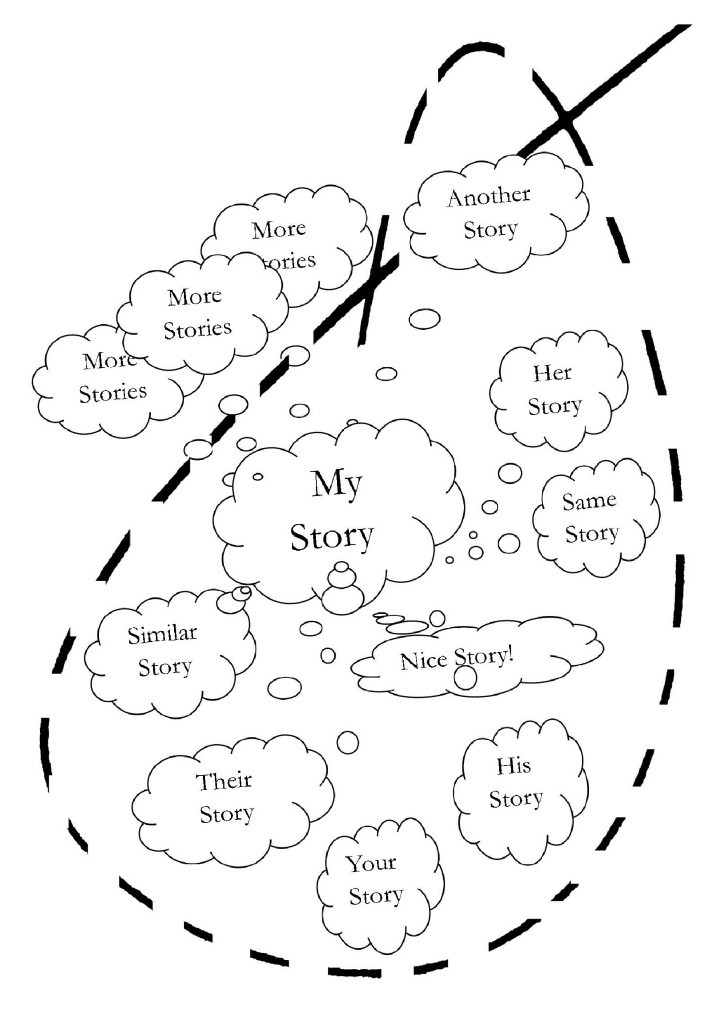
When we see a bunch of people on the street joyfully laughing and playing, our own spirits light up. If inhibitions are holding us back, we feel like dropping them and jumping right into the fun.  In storytelling, the listeners’ minds begin to likewise log in, plug in, and salsa with our imagination and train of thoughts. They do this regardless of how much or how little they know about the story background or about the storyteller’s experience. This is because as we create and put up verbal holograms/holographs in the conversation space, the listeners also set up movie screens in their minds and watch movies of their own making, with themselves as the main character.  The movie we are putting across through storytelling inspires and projects a parallel movie in their minds.  The images, colors, sounds, and drama in our conversations spark multiple, similar, copies of scenes running in the minds of our audience. This is magic in action.

1-SciencStory-721x1024

Illustration 1: When you start telling a story, it helps others recall and relive their own stories, their own experiences.

This is exactly why the streets of Hollywood glitter with gold. Because in our minds and in the minds of countless audiences, we all think and believe we are part of the magic and mystique that rises out of Hollywood. In my mind, I am Peter Pan or the Lone Ranger and you must be Dr. Livingstone, I presume?

This is synergy and co-creativity in action.  This is the real story behind the power of storytelling.

Now, the third most powerful thing about stories and storytelling is the fact that they impact the deepest part of our brain and our emotions. They cut through our cerebral defenses and sink in. What are cerebral defenses and  why do they have to be surpassed? The human brain of a newborn baby comes with some pre-embedded coding towards his traits and character. These are acquired from parental traits and characters. This is genetics. Right after birth, the newborn baby’s brain starts to absorb and accumulate data from what he sees, hears, smells, touches, and tastes. This data gathers fast, accumulates rapidly, and integrates really swiftly in early childhood. All this data is acquired and stored in the form of pixels, sound bytes, touch and other modalities of sensory inputs.

Most of the data that is primarily absorbed, accumulated,and integrated acquires importance over time. They maintain their importance throughout our lives. We call them our values and beliefs. We can be, and we do turn emotional about our values and beliefs.  Emotions burst out from thinking of things sensitive to us—images, sounds and smells that have been around us, within us for a long time. Our emotions, thus, are the stories of our lives.

All forms of communication address and tap into recent memories that are not ancient or primal to us. Storytelling is the exception.  All other forms of communication connect with images, sounds, and smells acquired not so long ago that reside in our recent memories. This neighborhood of our “recent” memories is a highly congested, constantly active desktop of chaos and novelty. And the older and tender memories of our growing years fear and avoid such chaos and congestion.

When narrating and listening to stories, the sights, sounds, aromas, textures, and flavors from our growing-up, formative years begin to surface.  They burst through the fear of the current, cerebral chaos and part through it like an old, bearded man once mythically parted the sea to get his people across to the other side.

Every time we tune into a story, the chaos and the confusion of cognition fall away to make a path so our emotions easily dance with the emotions expressed by the storyteller, as we see and hear them. Every time our emotions are happily touched, we become eager to do something, to take action, to build new things, and to stretch our limits as individuals, communities, and organizations.


Check out my book, the HeART of STORY, organizational and leadership storytelling…


the Truth behind Stories: the HeART of STORY

The reality today is very few people in the world want to see or hear the bold truth. In fact, the bolder and starker the truth gets, the lesser attention it receives. It can, more often than not, be despised such that people thwart and rebel against it. And yet, the same beautiful truth when wrapped in color, garnished with flowers, and accompanied by song can become a reigning reality. That is the power of Story. Stories are core Truths wrapped in roses, rainbows and rhythm. That is the story behind storytelling.


HISTORY OF STORIES

Eons ago, when man discovered fire, he also discovered the wonder of telling stories around that fire. After a hard day’s hunt, he would gather his tribe and begin to converse and tell great stories. He told stories about the source of life, about the sun, about the moon and the stars. He also told stories about the time and place where the sun was born and how the moon romanced it. He told stories about how the moon pursued the sun and died every month to be reborn to love the sun all over again. He told stories about how every individual had a star of his own up in the teal and midnight-blue skies.

Day after day, night upon night, from one season to another, man told stories –tales about love, courage, adventure, conquest, and wars. Around the fire, he told stories of ferocious Spartan warriors and heroes that battled one-eyed giants. He told stories about birds that could fly into the sun, burst into cinder, and then rise again from the ashes to fly right back into the sun.

Over the ages, stories of tradition, honor, and great courage ruled the air around the fires. There were stories told about great escapes, bold robberies, and giant shipwrecks. Discoveries were reported about new worlds, new wealth, and new people. Narrated with rhyme, repetition, and rhythm, all these stories were etched on the walls of the caves where our ancestors lived and into the hearts and minds of all mankind. Shadows and echoes from the flickering fires left unforgettable legends visualized and represented on the walls of our current homes. Today, many of these stories have become a large part of belief systems, of our culture and our tradition.


Taken from the book, the HeART of STORY.