

Facilitation and Midwifery

,

Ever since I took a deeper dive into the art and science of process facilitation, I have not been able to shake off the apparent similarity between a facilitator and a mid-wife. Yes, that is correct; it is a hard image to erase once it gets etched onto your mind.

A year or two ago, the image increased resolution and clarity when Certified Professional Facilitator Theresa Ratnam Thong of Malaysia said; “Sometimes my clients just call me and ask me to just be present during their proceedings. They just like for me to be around.” “Like a holy ghost,” she added laughingly.

A mid-wife does not carry any intention of becoming a parent to a child that she helps bring forth into the world. She was not there when the desire to conceive came about. She will not be there once the child develops into an adult and into a productive citizen of the world. She begins to turn up, support, counsel, observe, listen, guide, energize, nudge, advice after conception, and all the way until the newborn catches a glimpse of a new sunrise. She walks away from this creation with a little token of gratitude from the parents and a lot of satisfaction from having helped bring forth a new life. The intention, the outcome, the short and long-term benefits of this new creation belong to the family.

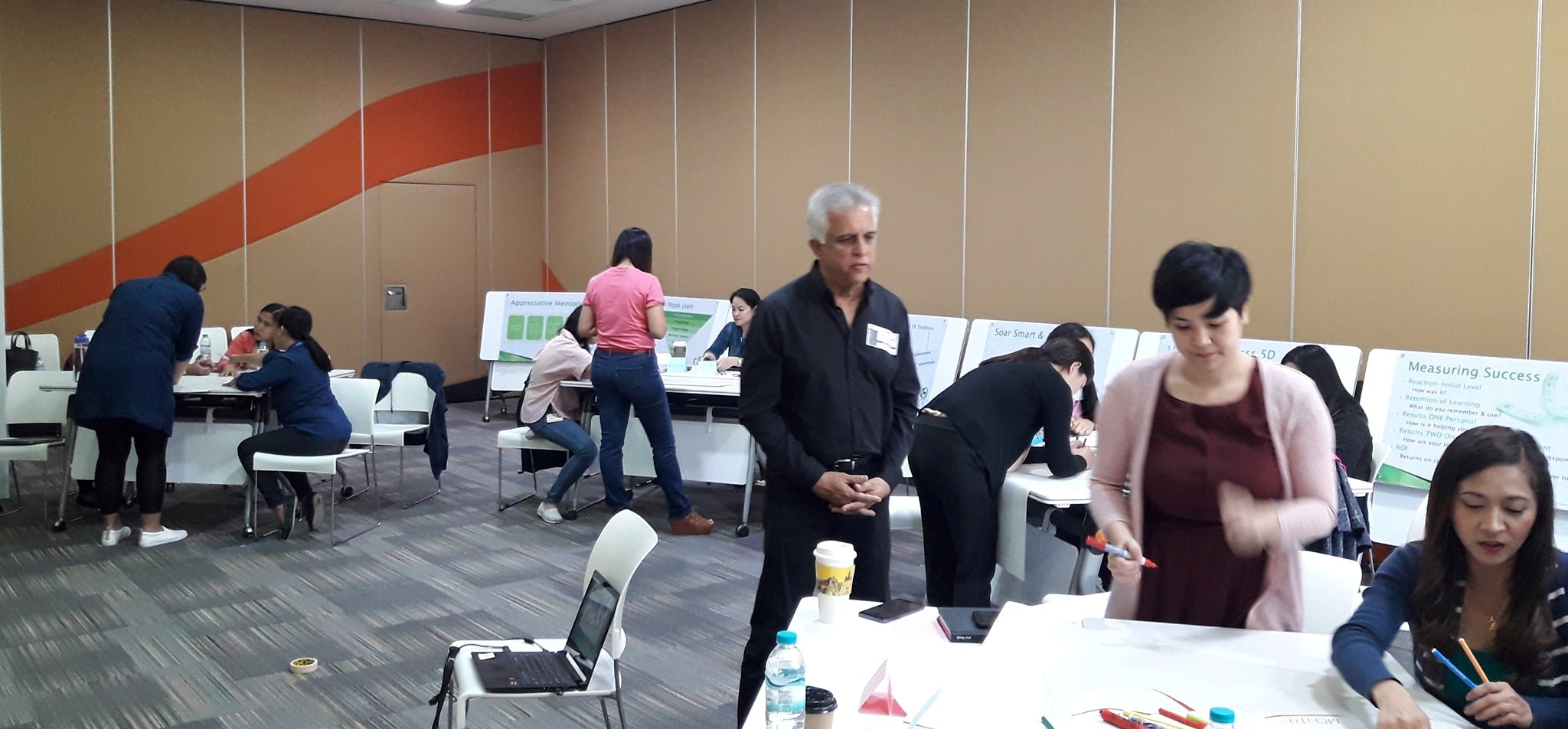
The knowledge, skills, and behaviors required of a proficient and professional midwife are not far apart from that of a process facilitator. They need to acquire and maintain updated knowledge in the field. They need to own and operate many soft techniques and tools that contain and care for the process and the outcome. They need to plan, prepare, and collaborate deeply and trustingly with the parents.
The three essential things that both these angels of change and co-creation need to consistently do are:

One, become really and truly good at what they do. Day in, day out all the immersion into acquiring new knowledge, building skills and minding behavior needs to have one singular focus and that is to serve the needs of the client, the customer, the need for creative construction.

Two, stay flexible and fluid to the dynamics of change. Keeping the client-desired outcomes in mind the facilitator must live and thrive in the moment of what constantly emerges. Fuel the emergence gently when it is virtuous and empower the client to stretch and own the change when it is not.

Three, strive to stay invisible in the present and become redundant in the long-term. No better glory in driving change when the change recipients come and claim that they did it on their own and they can continue to evolve and grow on their own.

The service quality and mindset of this mid-wife in rural Pakistan are worthy of applaud and emulation. The way to let others shape their own tomorrow is to be there when they need you and become invisible way before, much before they begin to lean upon you.

Essentially, between facilitation and midwifery, go be holy and be a ghost too until a new vision and a new life takes form.


Raju Mandhyan


Forgiveness and Leadership

,

I hear it is a good thing. I understand the world expects it of me. I also trust it heals and sets me free. Yet, I have been holding off talking about this for a decade now. I was under the impression that forgiveness was the stuff that preachers and pastors talk of. Yet, every time I helped nudge a leader back into form, back into productivity, the work that, mostly, needed to be done was for them to let go of something that was weighing them down so that they could go on to something that would heave them up. They needed to let go. They needed to forgive.

Then I must also confess that every time I, personally, wanted to reach upwards I had to let go of something that was holding me down and grounding me downwards. That something was usually a disappointment, a trauma, a grudge, a failure or even just an unqualified, irrational, hallucinated fear. And, all of these causes and ‘uncauses’ had to be managed and let go of before any and every leader could climb upwards. And, by the way, everyone has leadership potential in them and thus everyone is a leader or a leader in the making. Yes, you too.

I bear grudge to a former boss who thought that I was way too green behind my ears and treated me likewise. I bear a grudge against a business partner who sabotaged contracts because of our differences in ethnicity and backgrounds. I resent customers who take their business to others because they are blood-related and not because they serve and deliver better.

From an authentic leadership perspective, all these reasons are shallow. They are ‘uncauses’ to be holding grudges, resentment and even anger towards others. An executive within an organization and a leader in social and business circles grows, blooms and inspires others when she can overcome malice, move on to a better place and better productivity for all.

How?

Not just conceptually but in practice, in reality. Literally.

How?

First, on a piece of paper briefly describe a grudge you hold against another. Practice precision and brevity in the description. Yes, okay to be emphatically expressive but be succinct about it. Let the written paper rest. Walk away from it for a while, maybe for days. There is a good chance that when you get back to it, you will have or will begin to separate fact from mental fiction. You will become objective about the incident, the behavior and the people involved.

You see there is a fine line that divides the objective truth and the conjured up, victim perspective, truth in our minds. It is similar to the fact that rational thinking nodes and the romanticizing nodes in our brains are not very far apart. Giving our thoughts and emotions a little space and time allows them to segregate.

Second, when you recognize the difference between self-generated illusions of hurt and deliberate damage done by another then make a cognitive effort to place yourself into the shoes of that another. Think of answers to questions like:

Forgiveness and Leadership

Forgiveness and Leadership

  • What background do they hail from?
  • What kind of experiences and exposures have they lived through?
  • What are they trying to shield, protect or prevent from happening?
  • What might be their real agenda behind their behaviors and their machinations?
  • What might they be afraid of?
  • From their point of view, what might you represent for them?
  • What might you, consciously or unconsciously, have done to annoy, hurt or scare them?

Third, visualize what your issue might look, sound and feel like to an absolutely open-minded and neutral witness to your relationship. The way to go about it is to think of critical incident or an issue occurring between two of your friends and what might the opinion of a teacher, a coach or an elder be about that incident.

  • What would a teacher, coach or an elder have to say about the grudge you hold against another.
  • What would she say or do?
  • How can you emulate the words and actions of a person you consider kind, compassionate, and a clear thinker?


As you will yourself and as you stretch your mental and emotional muscles to go through these three steps the person and his actions that caused you ire become less and less important to you.  The clarity and heightened resolution of that anger begin to fade away. Eventually, the target of your ire begins to fade and begins to reform, rebirth in your mind as another individual, another ordinary, simple human being just like you.  You might also want to share your thoughts with a friend. You might try rehearse a conversation and a dialogue with the one you want to forgive. You need not take this up in reality. You are only taking this up to cleanse your neurological system of toxicity. Just the process lived out vicariously helps a lot.

It is a slow, steady process. It requires persistence, faith in your abilities to succeed, and a certain mental discipline. It cannot be achieved in a day. It can be achieved the same way you acquire and build a new habit, or a new muscle.  The more such forgiveness muscles you build the stronger a human being and a leader you become. Just like a good fitness regime that needs to be supported by a good diet the ability to forgive requires that you choose your thoughts, words and actions again and again. When you find yourself sinking into anger, resentful and depressive thoughts about a person or incident go for a walk, a run or a trek. Mind the choice of your words and conversations with others. The more recklessly you talk ill of others or of negative incidents the more they flourish and solidify in your own mind. We are all auto-telic. We have malleable brains and we shape them by will, thought and behavior. We become what we constantly think about. Think about being angry and upset over a past grudge and you become a depressed and angry person all across.

  • Leadership is about being aware, being agile, and grasping moments that will innovate, change things.
  • Leadership is about journeying over a distance, over to a better place-a vision of a brighter future.
  • Leadership is about including others, millions of others, and enrolling them to move forward by moving yourself.

All this can be achieved with grace and with gumption. Grace to accept and gumption to let go. A leader, all leaders need to stay light and unburdened and they need to move on ahead with deliberation and purpose.

At the end of it all. At the end of all your striving and struggling if you are unable to let go of nasty, toxic memories; if you are unable to forgive others then forgive yourself for not being able to forgive others.

Alternatively, better still, start the whole forgiving process by forgiving yourself first. Yes!

What to believe in times like these

It is true that our beliefs drive our behaviors and our behaviors drive our growth and progress in life and in our businesses.

It is hitting month EIGHT since COVID-19 turned the earth inside out. There is very little to tell you about why and how it happened or, even, what the consequences of this massive, tsunami of a disruption are because are experiencing them.

The question is what should we do get ahead of this. What should we do to progress? How do we behave and what should we believe in?

At Inner Sun, we have a belief about beliefs. We believe that beliefs are put together by three dynamisms.

The first is the dynamism that is innate, congenital, and embedded. In an individual, it is sometimes referred to as nature or personality; in a business organization, it may be referred to as “work culture”.

The second dynamism is the one that exists outside of this system and is of many forms; the way that it is often referred as the environment, the economy, or the ecology.

The third, the most vibrant, with a high potential to influence the inner and the outer dynamisms, is the dynamics of the process between the internal and external systems.  It is the process of combustion between what is and what is possible. This is where innovation and change is carved out. This is where a new life and a new world is born. The drivers of this intermediate dynamism are the first is the dynamism that is innate, congenital, and embedded. In an individual, it is sometimes referred to as nature or personality; in a business organization, it may be referred to as “work culture”.

In these blazingly vibrant and challenging times, individual and organizations need to huddle up and closely watch what is happening with our own awareness, intelligences, emotions, memories that we are accumulating, and the actions we are taking.

Organizations and individuals, in recent times, that have trusted these two beliefs have a robust potential not just to survive but also to thrive in the coming days:

Believe that there are better days ahead. Yes, those that recognize that this is one of the seasons of change in a larger sense and that spring is just ahead staying optimistic and enthused about what they do. “The essence of optimism is that it takes no account of the present, but it is a source of inspiration, of vitality and hope where others have resigned; it enables a man to hold his head high, to claim the future for himself and not to abandon it to his enemy,’ said Dietrich Bonhoeffer.

Believe that we are all in this together. However, in a commercial sense, competition is good but in these challenging times, it is collaboration and compassion that are key to progress. “None of us, including me, ever do great things. But we can all do small things, with great love, and together we can do something wonderful,” claimed Mother Teresa.

The higher the intensity and the quality control of these elements the better the results and the outcomes for tomorrow.

Think about this deep and hard. These things will boost your beliefs onto a better place and thus influence your behaviors towards progress and growth in these challenging times.

Dumb to Dumbstruck to Dumber

My apologies if highlighting this thing annoys you. It might if you are the perpetrator these things. By these things, I mean the excessive use of plastic products.

Way before COVID 19 had hit us, our forests and oceans had already been hurt by the plastic waste that abused their beauty and their purity. That was dumb.

For a few crazy weeks during the global lockdown, nature had begun to bloom again. The air had cleaned up, the oceans had become pristine and the flora and fauna had begun to bloom. That was because we were dumbstruck by this change.

Then as our fears reduced and the desires to become productive again, rose we made some moves that surely were dumber. Our consumption of plastic and synthetic products just shot through the roof: masks, shields, curtains, acrylic dividers, and on the streets of Metro Manila motorcycle riders’ doinked up a large sheet of acrylic between the driver and passenger. That was actually the dumbest thing to do.

Check what UNCTAD has to say about this:

It is a societal flaw that when faced with a crisis we respond with short-term solutions than long-term. If we just pause to reflect twice rather than just once, we can and will come up with better solutions to all kinds of problems. No point in, habitually, going from dumb to dumbstruck to dumber.