
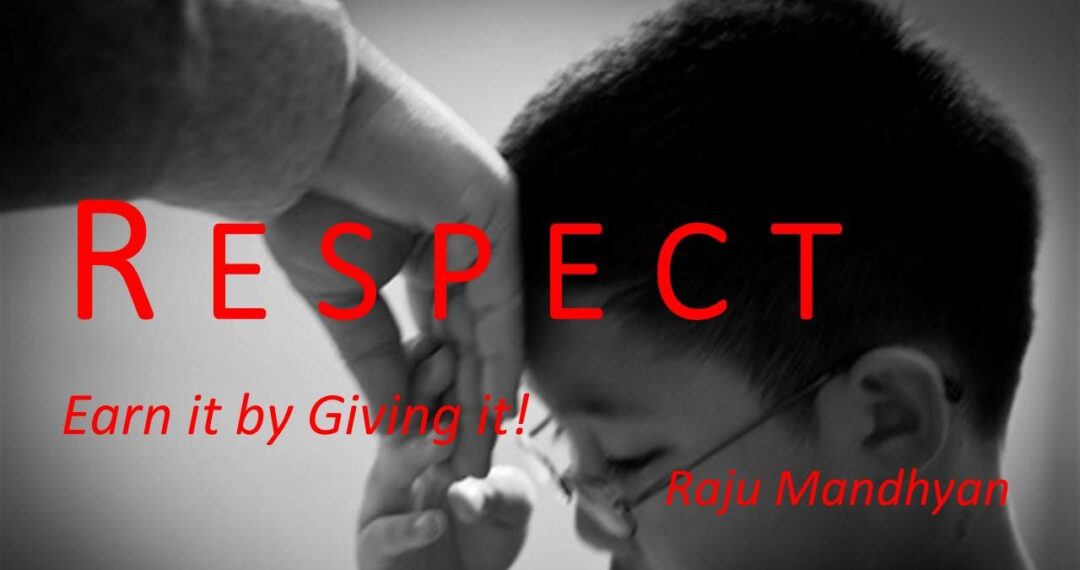
R E S P E C T, Earn it by Giving it!

,

Respect is an essential currency of exchange with family, at work and with society.

The ABC’s of earning and accumulating respect are quite similar to earning and accumulating financial wealth. You can be born, or get married, or sneak into a position of power and demand respect.

On the other hand, you can honestly work your way up and become a self-made man of respect.

You can also go flat broke at it.

Several years ago, a c-level department head came to me claiming he had lost a lot of respect among his workers. He was the head of logistics, had seven managers and another 200 people working under him.

My people do not like me, engagement has dropped and work is suffering, he said.

He was new to the company, to the culture and the country. After an hour or so of probing, we uncovered the root cause. One time, he confessed, he had spoken harshly to an elderly colleague in the presence of all others. She was hurt and insulted; he had robbed her of respect. Her teammates and eventually the whole department empathized with her. In return, they too turned cold and indifferent towards him.

It has been six months, Coach Raju, what do I do? He cried in pain.
R E S P E C T

Can I go and apologize to the person? Nope, it will not help. It is a shy, relationship-oriented culture.

Can I call them all over for dinner and do some bonding? Nope, it will seem like a bribe and cause more harm.

Go the front end of your logistics department. Work with the drivers, the maintenance and the messenger boys. Treat them with courtesy, care and respect first. Be humble, remember their names and get to know them better, I offered.

He agreed and worked at it diligently. Six months later things began to look up. Slowly, he began to get into the good books of everyone. His respect balance sheet began to glow in his favor. He was getting it back because he was giving it away authentically, truly and humbly. His changed behavior began to influence the company culture. He was a happy man.

With tiny errors such as his our respect, our reputation can come crashing down like a sheet of glass. When it has to be put together, it has to be put together piece by piece, shard by shard. Sometimes, it can never be put back together.

So I use what I call the ABC’s of Respect.

What are the ABC’s of earning respect?

The A is Awareness. Become highly aware of the ambiance, the atmosphere and the accoutrements of respect around you. Watch people, appreciate diversity and understand rituals. Find your place and niche in the world. Your heightened awareness will improve your appearance in the eyes of others. And, they will return that favor to you.

The B is for your Beliefs. Do you believe the world is a lousy, unhappy and a sad place? If yes, then your behavior will follow your belief. Do you believe that it is a dog eat dog world then your behavior will bark at others. Generate an abundant mentality and your behavior will become affirmative.

The C is for Conscientious Communications. Select each letter and word as if you were picking flowers. Morph them positively. Bead them like a garland towards energizing others. My father, a tailor in India, used to say “Son, measure twice and cut once.” The same applies to communicating, think twice and speak once.

Do all this consistently, compassionately and with authenticity. Overtime you will notice that respecting others is a fruitful investment that brings you exponential returns.

Sometimes, money is called the root of all evils. Respect surely is the fruit of all that is good. Yes!

That is true and authentic power. That is how to grow and thrive

Trust by Raju Mandhyan

How to Trust and Acquire Trust

,

Tony Meloto is to the Philippines what Mohammed Yunus is to Bangladesh and what Jimmy Carter is to the United States of America. They are all founders of these NGOs that support the underprivileged. Tony Meloto gave up a lucrative career to build and grow Gawad Kalinga, which means to bestow care and support. In the last 25-30 years

Trust by Raju Mandhyan

Trust and Acquire Trust

they have built millions of humble homes across the Philippines, Asia, and the world. The initiative is creative, colorful and has succeeded with flying colors. Money, support, and volunteers flood in from all walks and all parts of the world.

One day at a conference that I was hosting, I cornered Tony Meloto and asked him how he manages this incoming wealth and support. How does he screen, filter, sort, and keep the whole thing transparent and running ethically? Are you not worried about corruption, politics, or fraud?

He paused, looked at me gently, and said, “We begin with trust.” We begin by first giving it abundantly at the get-go level, at the face value of the donor and the volunteer. In return, he said, we get it back trust back in spades and shiploads. That is how the system is structured, and that is how it works and it has not failed us so far. When we grant trust to people, they rise up to our positive expectations and often surpass them.

Such is the essential nature of trust and humankind. We wish to be trusted, we wish to trust others and the exchange occurs when we lead by offering it first. The offering of trust journeys through three phases. Call them the ABCs of trust. That is it needs to journey through appearances, behaviors, and communications with others.

When we regard another human being our deepest brain, the Amygdala, and the Hippocampus sections, within seconds makes an assessment of whether we like them or not; whether we should fear them or not; whether we should trust them or not. Thus, at this appearance level take in this assessment as data to be used for an integrated analysis of whether they can be trusted or not. Refrain from passing judgment just yet. Refrain from taking any action just yet. This information is only a third of the information needed to come to a conclusion.

The second phase is that of us watching and sensing their behavior. From years of watching and dealing with people each, one of us has a storehouse of behavior matching cards and metrics by which we assess likable or dislikeable behavior. Take note of these feelings, nudges of thoughts triggered by past memories. This is valuable data. Perhaps enough to come to a conclusion and then act but exercise pragmatism and hold back from judging the book by its cover.

The third phase is that of us listening to their words, their thoughts, their ideas about work and life. Hear them out totally. Maybe their appearance and behavior might be the total opposite of what they say, claim and commit.

Now you have data gathered from three different sources, three different modalities of communications. You have data gathered from sight, sense, and sound. Each of these sources has provided fodder that is data to crunched by our three brains; the deepest brain known as the Reactive brain which processes in the most primal way. We have behavioral data to be processed by our mid, limbic brain known as the Romantic brain and then we have data, cognitive-spoken kind, to be processed by our neo-cortex known as the Reasoning brain.

When all this data is done processing by these three brains and the final analysis compliments each other then you have found congruence. Then you have found trustworthiness. Now you can move ahead, take action.

That is the neural pathway, the journey of the thing called trust. That is how we trust and that is how we begin the process of trusting. Tony Meloto and Kalinga warriors, of course, do this in an accelerated way. They do it in a way that works for them fine and fruitfully.

What does it take from us, from leaders to trust others, and let our minds journey through these three neural phases?

It takes observing people through lenses that have the least possible bias. I am not saying without any bias, I am saying with the least possible and by staying conscious of our biases. If we observed people without any bias then we would have no opinions whatsoever. Thus, watch people closely, wholly, and gently.

It takes becoming sensitive to people’s behavior. It takes noticing and understanding of why people do what they do. It takes recognizing what kind of emotions are triggered with us when we watch and sense other people and their actions. It is about awareness, sensitivity, and being intelligent about emotions.

Finally, it takes active and acute listening to take in all that is being said and also exploring and understanding parts that are, sometimes, left unsaid.

These three phases of trusting others are tied in to three things we need to do, and all of them are in alignment with the structure and processing system of our triune brains. When we gather optimum data gently and process it quietly and thoroughly our abilities to assess and trust others improve.


Acquiring trust, on the other hand, is the reversal of this three-phase journey. When we want others to trust us then we must offer them the correct and honest appearances and presentations of ourselves. We need to let them see us plainly and openly. Masking our appearances is going to give others the heebie-jeebies over us. We need to become conscious of our behaviors and actions in the presence of others. Raising your voice, moving frantically or even positioning yourself where there is a lack of light will make others wonder about us. Lastly, thinking well before speaking gently and succinctly about things helps others get a clearer picture of us. It helps them go through the process of integrating the data and the analysis through the three phases and with the triune brain efficiently. This when practiced with consistency builds relationship trust. We can do the same with acquiring trust in our competencies; be good at something consistently.

Building a culture of trust in other organizations is an enhanced and a multi-layered approach of this interpersonal process of giving and acquiring trust. When the process becomes clear to the leaders of any organization, they begin to live out the process. Living out the process makes it habitual and, eventually, becomes second nature to leaders. When leaders are good at giving and getting trust then the philosophy and the practice cascade across to become the culture of that organization. Trust me.