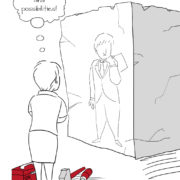
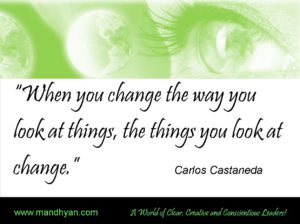
Change the Way you Look at Things, The Things you Look at will Change
,

by Carlos Castaneda

Zig Ziglar shared this story a few decades ago,

“Growing up on a farm, I’d have to be up way before dawn and one of assignments was to milk the cows. The cows did not know that it was their job to let me get milk from them. My assignment was always tougher in the winters of the great state of Texas. The milk inside the cow, in my mind, was usually frozen. I hated the job and hated the cows.

Over time I realized the more frustrated I was at the job and the cows, the harder my job became. And, I am sure the cows also went out of their ways to make my life miserable too. Then I decided to change the way I looked at my job. I decided milk was good. It brought health and nutrition and income for the family. I began to look at the cows with kinder eyes. I even went out of my way to have a chat with the cows before I even touched them.

“Sally,” I’d say to the eldest of the cows, “you look good today! It seems like you had a good night’s rest.”

“And Martha,” I’d say to the youngest, “that smile on your face is gonna’ take you places, y’know!”

“You cows have no idea how much we enjoy and appreciate all that you do for us. If not for you guys, our breakfast tables would be dull and boring. Thank you. Really, thank you!”

He had no measure for it but Zig Ziglar was sure that on the days he appreciated the cows and thanked them for being who they were, he usually picked up a few extra quarts of milk.

People at work and, in life, aren’t any different. All of us need appreciation and grace from each other. All of us need to learn regard each with respect and kindness. When we look at each other, when we behold each other our eyes need to zero in on the potential and grace that lays hidden in each of us. Yes, it does!

The moment we seek, zero in and stay positive about that hidden potential our attitude and our outlook becomes the water and sunshine that unleashes that potential. When we change the way we look at people, the people we look at will change and grow into and fill the frame we perceive them through. This is powerful medicine. It is the truth and it costs nothing. Nothing at all! In fact, it is like oxygen to your own wellbeing and happiness.

On those cold, wintry mornings the cows, I hear, also returned the favor to Zig Ziglar  with a “Thank you for a warm hand on a chilly morning.”
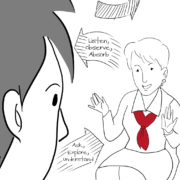
Listening With a Willingness to Change

, ,

Listening by Raju Mandhyan

It sounds like a mouthful compared to active listening, deeper listening or, even, empathetic listening and yes, it is.

After having had thousands of discussions and practice sessions in communications, coaching, sales and other leadership workshop I realize I can put this in a nutshell.

When wanting to listen and listen well, what do we do? We sit up. We shut off other thoughts. We pay attention to the lips that pour out the words. We turn up empathy and, yes, we smile-nod-twinkle and go uh, uh. Yeah!

Or, again, there are times when we are doing all that externally and internal parts of our self are going “what time is it, I wonder?” “is she wrapping by now?” “this is not what I came here to listen!” “he has no idea what he is talking about!” “I am so much better a thinker-communicator-what have you!”

Active listening is all bright-eyed, big smile and nodding approval kind of a listening. Deeper listening is reading between the lines and “feeling” things rather than just hearing the words. Compassionate listening is, really, getting ready to say “Oh dear, I know exactly what you are going through but let me tell you about the time… yadi-yadi-ya!”

Real listening is all of the above on the surface. Underneath, deep inside you the communicator, leader or a coach needs to be ready to give up all that is bright and beautiful inside you. You need to be ready to surrender all beliefs that you hold dear. You need to forego everything else that you have been planning to bring to the table.

  • You need to surrender your position of listener-leader and be a follower.
  • You need to give up the idea of wanting to offer wisdom, create value.
  • You need to accept, lovingly and respectfully, the thought that what is presented may be better and productive.
  • You need to become ready to let go of all that you think make up you.
  • You need to be listening with a readiness and a willingness to change. Yes, change!

Listening with a readiness and willingness to change from the depths of your thoughts and the bottom of your heart, you need to be ready and willing to change. That is listening.

Any movements towards change can only come about if the cornerstone of our interactions is an honest-to-goodness willingness to change. All this, mind you, happens in fractions of seconds. That fraction of a second will make you a leader that was ready to change.

The Night of the Jitters

,

Leticia Ramos-Shahani

I was once invited to compére a dinner function where there were several speakers. The chief amongst them was a lady Philippine presidential candidate. My job was to stay within the theme of the evening, introduce the speakers, and keep the transitions lively, entertaining and contextual.

Easy? Yes, if not for an audience of over a 400 people!

Weeks and days before the event, I gathered the material, read the resumes of the luminaries, prepared my lines and timing. On the day before the event, I had everything down to a pat. But at night in bed, the next day seemed bigger and scarier than most other days.

I tossed and turned restlessly until late into the night. Finally, when I did sleep, I had a nightmare. In the nightmare, I was up on the stage next to all the speakers. The lights were strong on my face. Awed by the crowd, I was in a state of shock. Suddenly, from nowhere the lady chief guest walked up to me, handed me the microphone and said, “Raju, it is your turn! ”

My turn! I grappled with the dozen or so pages in my hands and walked up to the lectern. At the lectern, my papers flew from my hand and circled around me in slow motion. The microphone turned into a cobra and stared me down. And, when I looked down at my finely dressed audience they had changed. In their place were people of all kinds. I saw fishermen, street hawkers, and gaunt-faced ladies with cigarettes dangling from their lips. On the floor there were hundreds of crawling babies screaming at their mothers to stop smoking and pay attention to them. My wife was in the crowd begging everyone to calm down and listen to me, the speaker!

The back of the hall had somehow changed into a railway compartment with dozens of big, African-American men playing basketball in it. Big, burly men with beer mugs in their hands were watching the game while the train of my speaking moment was hurtling away towards nowhere!

In the nightmare, I heard someone knock at the door of the railway compartment. Covered in cold sweat, I woke up with a scream in my throat! As I sat up in bed, I recognized the absurdity of  the whole situation. The demons of anxiety and fear were playing games    with my mind.

The knocking on my bedroom door was real, and I walked up to it and opened it. There stood my little 7-year-old daughter, crying for her mother. I picked her up and held her against me. My fears subsided and a smile took over my jitters and doubts.

I was overcome by an inner peace and calm. I went to sleep assured that tomorrow, I was going to perform for a crowd not go to war with the world. My fears were gone and the material that I had been working upon became mine. The next day I dazzled the crowd and the lady chief guest at the dinner  function.


Note: I post this in honor and the love I, like, many have for the late Senator Leticia Ramos-Shahani of the Philippines who just passed away this morning of 20th March, 2017.

Emotionally Intelligent Facilitating

,

Out there, there are shiploads of ideas, opinions and practices about being Emotionally Intelligent at everything. Here’s hoping that what I say stands out and answers the needs of trainers and learning facilitators like myself.

Scores of times, I have seen trainers and speakers turn red in embarrassment or anger when faced with tricky interactions during training or facilitating a class. My most painful memory was that of sitting in the back of class where a young lady trainer, with deep knowledge about the subject matter and great presentation skills was head-locked into a semantic argument with an elderly gentleman over the English language.

The young lady was my friend and protégé. During her anguish her eyes connected with mine looking for compassion, strength  and support. For a minute I was tempted to respond to the appeal for help in her eyes but I stood my ground. Seeing her anxious my heart was pounding but I had faith in her good intentions and her abilities. Soon, she was able to pacify the man and continue creating value for the rest of the class.

We never spoke about the incident but every time we meet the story resurfaces in our eyes.

Now for myself and for scores of trainer-speaker, facilitators like me here are a few ideas and insights on how to be emotionally intelligent about facilitating high-intensity, purpose-driven conversations.

Know Yourself Well

Oh, you’ve heard this a thousand times! It’s also the very first paragraph in my first book, the HeART of Public Speaking. Plato, Shakespeare and even Johnny Carson might have said it many more creative ways.

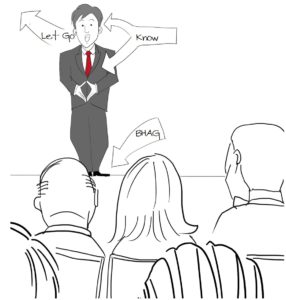
Know what you value. Know what is important to you. Know what your task objectives are. Know your audience-learner needs are. Know your subject and strategies to facilitate.Yet, be open and flexible. A learning interaction or facilitating group think is a co-creation and a co-production.  The bottom line is that the Big, Hairy, Audacious Goal (BHAG) of the interaction must be easily and harmoniously met. All players must walk away happy, healthy after digesting a hearty feast of new principles and practices.

Assess Others, Not Judge Them

Never address them as “the trouble-making elderly gentleman,” as I have done above. Stephen Covey said it rightly, “seek to understand, before beating them down to prove yourself right!” Well, that’s not exactly what he said but it just sounds so much better this way.

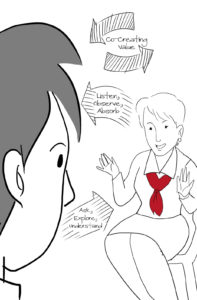
Assess them. That is after you observe, listen, observe, feel then you must ask and explore them with caution and care to understand. Being emotionally intelligent is being able to see their world from their viewpoint and then, if necessary, with compassion show them a different view. If you get hard about your opinion of them then you will not be able to help, teach, train, lead or let them evolve.

Manage Your State and Stress Levels Smartly

Working a room drains the brain like very few other activities. Talking, teasing and then training a large group is like doing a triathlon, Zumba and meditation at the same time. It is very fulfilling and, yet, very exhausting. For decades now, and I can’t change this, after every focused group discussion, every workshop and every speaking engagement I need to rest and recover. The ratio of work to rest is usually 1:1.

So while in a learning session know that your state needs to cool, calm and collected. You need to manage and be selective about what your brain processes throughout the day. Tiny hindrances like an “elderly man not agreeing with you,” needs to be gotten over and trashed from your mind right away.

Your breathing, your heart rate and your body temperature always reflect how much stress you are building up. If you feel your pulse picking up then it is time for 10-15 minute break and get back to optimum performance levels.

Lighten Up!

Just because you are center stage does not mean that the show has to be a one-woman show. The burden rests on you but you don’t have to carry it all and, especially not carry it while puffed with self-importance. There are millions of trainers, speakers and facilitators doing almost the very same thing that you might be doing then. You are not alone.

So, take it easy. Good facilitation skills are quite like good sportsmanship skills. Pass the ball! Make it a team thing to carry the ball, the burden or the BHAG, as we call it.

What you do and what you create is important but that must not stuff you with self-importance. So lower those mustaches and let down your long hair a bit. Have fun. Laugh. Laugh, mostly, at yourself and you will find that the learning audience will help you at fulfilling the meeting objectives and also laughing at yourself. That is the HeART of HUMOR in communications.

Morph your Thoughts Correctly and Creatively

Beyond managing your attitude and behavior there, usually, comes a time where you need to speak up. You will need to air your ideas opinions, either in alignment with what is on the table or against what is being offered.

It is time to choose your words well. It is time to dissect the objective from the personal and then state it in the best possible way.

So think through what you have to say not just once but, maybe twice or thrice. A wise old tailor that I grew up with used to say, “Son, measure twice and cut once!”  I have never been more thankful to Dad for sewing that up in my neural pathways for life.

Say what you say to say in the shortest, sweetest and the simplest possible way and then let it play out as it will.

 Say what you Must, Assertively

I was partly playing with you when I said that you don’t have to carry the ball all the way to the basket yourself. You may not carry the ball physically and, even, mentally but you must carry the ball and the whole team spiritually.

Thus, there will come times when if not an elderly gentleman but a wayward teeny-bopper, or a teeny-bopper minded person may constantly be disrupting the procedures. That is the time to flex your muscles and use the “I” word and the use “I think,” or “I feel,”  and “I prefer” words. Yes, asserting yourself is about expressing what you think is right. It is in very rare cases, during facilitating, that you need stand on a firm, chosen ground.

When you assert yourself with firm words and preference, make sure to keep you voice warm and supportive. As a facilitator, small assertions can be made about achieving process objectives and playing by agreed rules of engagement. Warmth and compassion are, usually, about keeping the team together towards the bigger objectives.

 Seek Acknowledgement of Understanding / Repeat Creatively

Oh, this doesn’t mean, “I hope you got it, nitwit!”

No, never!

Instead, say, “I hope that answers your need.”

Say, “Those are my thoughts and I am open to hear yours.”

Say, “Is there any part that I need to elaborate?”

If such probing doesn’t get you what you want or doesn’t get you any confirmation, it is okay to repeat the point, differently, a few more times through the process.

The best way of course is to cite an example or tell a story. My bias is to tell a story. Read, the HeART of STORY.”

It is Okay to be Angry

Learning, training and facilitating a group discussion are all processes and processes fail or do not meet the mark. Sometimes, if our efforts or our participative work doesn’t meet the mark and if that annoys or upsets you, that is okay.

We are humans, flesh and blood, before we are teachers, trainers or facilitators. Acknowledging this fact and then recognizing what is irking is the first giant steps towards growing into being an emancipated facilitator.

Being angry and being stressed about the fact that we are angry is a double disaster. Acknowledge annoyance, locate cause, check your perspective, express your views and then change your view. “When you change the way you look at things, the things you look at change,” said the late Dr. Wayne Dyer.

Anger is okay. It means you are involved, you have a stake in the process and you care.

Learn to Let Go!

Okay, I am sure you’ve heard this one many times too. It’s been said by great personalities like Plato, Shakespeare and Elsa from the movie, Frozen. It is also the core idea in my book, the HeART of HUMOR.

Success at a project and failure of a process are both events. They are the two sides of a coin called life. The work we do is part abstract and part dynamic and there are no guarantees. “If you want a guarantee, buy a toaster” said Clint Eastwood once.

If your efforts at driving learning and creating value for others don’t succeed by your measures then recognize and appreciate the fact that you had good intentions, you made all the efforts, people turned up and probably took away something from the efforts made and from coming together as a group.

Most all the pioneers and leaders of the world go through multiple failures but they keep coming back, again and again. The world, the marketplace and the training room appreciate their dedication and perseverance towards creating value and, overtime, value does get created.

To Let Go is to recognize the power lies in churning up a storm, seeking synergies and being surprised with the results. Storming, forming, norming and acceptance are the essentials of life and learning.

Thus to be an emotionally intelligent facilitator-leader know yourself, appreciate others, acknowledge your feelings, express yourself, measure results objectively and learn to live with failure and celebrate all successes.

Oh, and yes, have fun!  Read again 🙂

The Sensitive Speaker

It doesn’t matter whether I do basic presentation skills or advanced executive presence training, one question that constantly pops us is “How do I convert my being sensitive of others into confidence in self?”

My experience and beliefs tell me being highly sensitive of others’ presence, their thoughts, and their opinion isn’t a shortcoming but an advantage.

Think of this, that while conversing, when you mind and monitor what feelings run through their minds is inside information. It is unspoken feedback and you’ve gotten access to it. Isn’t that an advantage?

Decades ago, a stern face or a disengaged audience member would scare and disrupt my chain of thoughts. And, when I’d approach them later, I’d be able to assess that most often than not there were other things on their minds and not just my performance. Soon, I began to challenge my own assumptions about their state of mind. Very soon I began to convert my being disturbed and disrupted into a turnaround in the conversation by creatively engaging the person that scared me by a quick question or by pausing and smiling at them. It was, for me, putting the NLP principle of “the map is not the reality,” principle into practice.

My thoughts and actions gave me an inside view of their state and my state changed for the better.  Not only did the technique change our state but also gave a power boost to whole performance with the larger audience in the loop. My being sensitive of others wasn’t and isn’t a disadvantage anymore but is an ace in my hand.

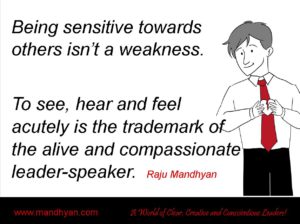
Being sensitive towards others isn’t a weakness.

To see, hear and feel acutely is the trademark of the alive and compassionate leader-speaker.

Raju Mandhyan

From the HeART series available at Amazon